Research
MIRA Lab (Medical Imaging Research and AI Laboratory) at Sejong University develops rapid MRI acquisition and physics-guided deep learning reconstruction. Our research spans deep-learning image reconstruction, rapid quantitative MRI, and motion-robust diffusion imaging for clinical and neuroscientific applications.
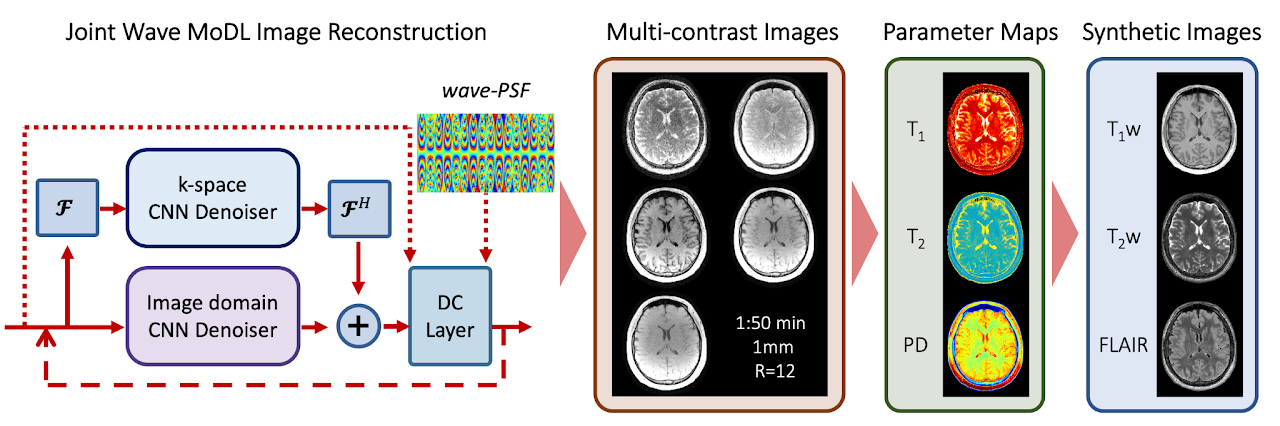
Deep Learning Based Image Reconstruction
Model-based deep learning (MoDL) folds CNN regularizers into physics-based parallel imaging with few parameters. We extend it with wave encoding — Wave-MoDL — combining unrolled network constraints with data consistency for highly accelerated, high-fidelity 3D imaging.
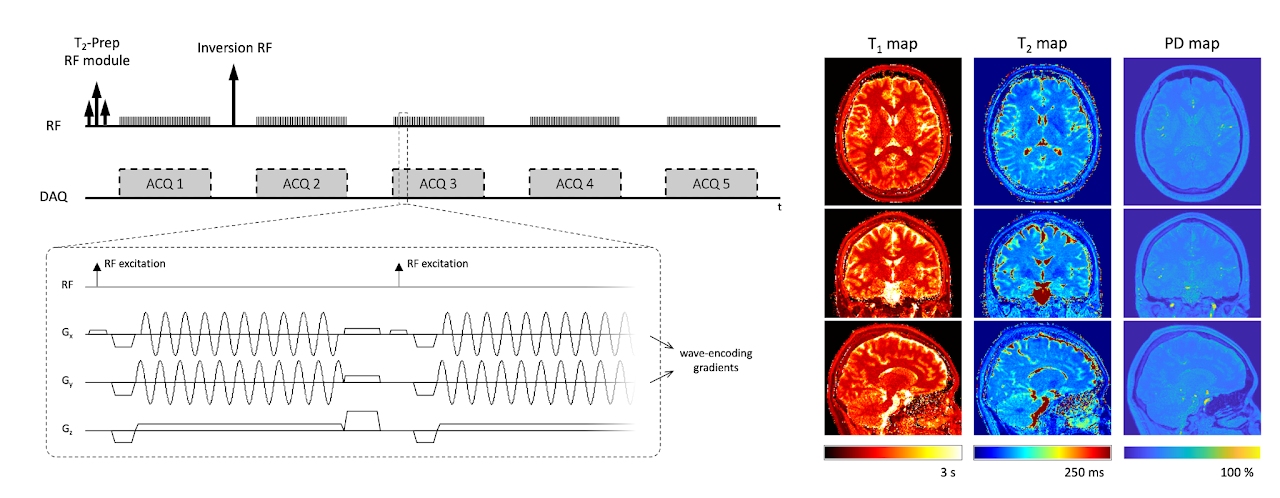
Rapid Quantitative MRI
Quantitative MRI (qMRI) estimates tissue relaxation parameters — T1, T2, T2*, and proton density — in absolute units. It reveals changes that qualitative imaging misses, but high-resolution qMRI is slow. We accelerate acquisition while preserving the accuracy of the quantitative maps.
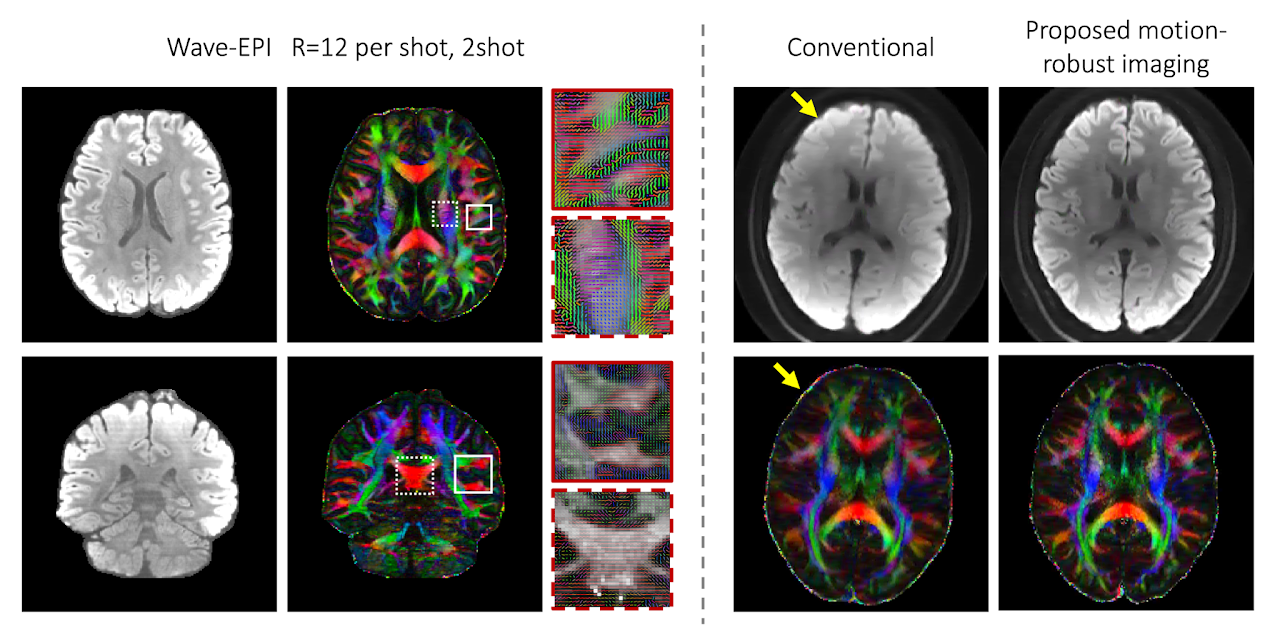
Motion-Robust Multi-Shot Diffusion MRI
Echo-planar imaging (EPI) is fast but distortion-prone; multi-shot EPI reduces distortion and blurring at the cost of inter-shot phase and motion sensitivity. We develop efficient, motion-robust, distortion-free high-resolution msEPI methods, including VUDU and BUDA.
Please feel free to contact Dr. Jaejin Cho at jaejincho@sejong.ac.kr for more information.